
As of March 2026, Minimum.com has been acquired by Novisto - cemeting Novisto’s position as the most comprehensive, "all-in-one" sustainability platform, designed to serve as the single source of truth for global enterprises navigating an increasingly complex regulatory landscape.

What it really takes to get to actionable carbon data
A lot of carbon accounting still looks like this: spreadsheets moving between teams, data processing that eats entire weeks, and emissions results that show up months after the decisions they were supposed to inform.
Most of this is because the systems in place weren’t built for speed, or for action. If you want timely insights, strategic clarity, and the ability to course-correct in real time, you need to rethink three things: how data comes in, how much of it needs to be touched by a human, and how quickly it gets turned into insight. Let’s break that down.
Make data ingestion effortless
Carbon accounting often inherits its workflows from finance: export to Excel, fill in a template, send it back. It’s familiar, but inefficient, and it breaks quickly at scale.
Add to that the fact that every piece of data arrives in a different format:
- Utility bills come as PDFs,
- Procurement data comes in whatever system each supplier prefers,
- Facility data comes buried in operational spreadsheets.
Someone has to manually extract, clean, and standardize all of it before any actual carbon accounting can begin. By the time data gets cleaned up, validated, and entered into a usable format, you're already weeks behind.
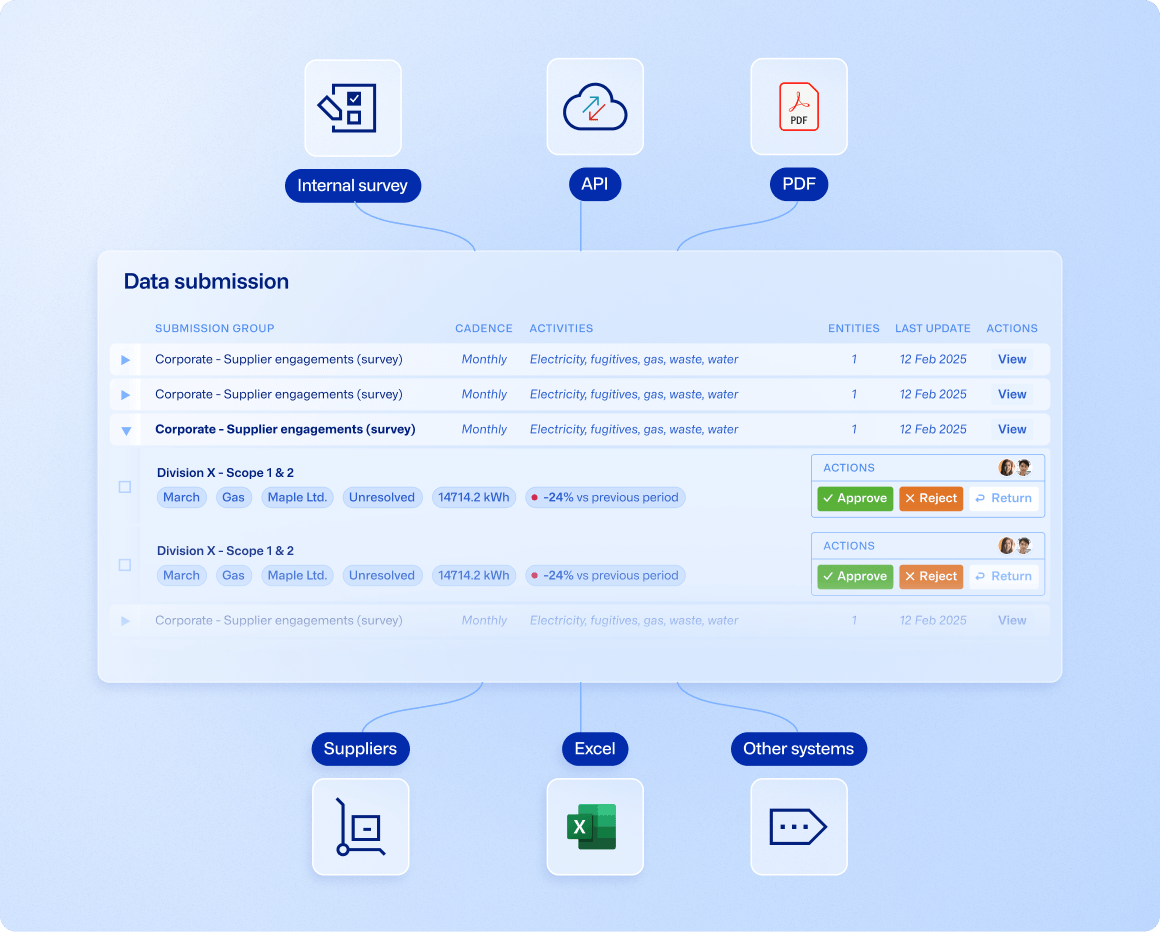
The alternative: flexible data ingestion. Systems that can work with data as it exists: invoices, PDFs, system exports, machine logs. No need for submitters to reformat, and no bottleneck at the centre to clean it up.
Unfortunately, consultants can't do this. And most softwares will ask you to pull the data into nice templates for them, leaving you to still do all the work.
In the best-designed systems, the central team doesn't need to see the raw data at all. Data owners can submit through a portal. The system handles structure, validation, and evidence-tracking behind the scenes.
The result: fewer errors, clearer audit trails, and a central team freed up to focus on the work that actually drives decarbonization.
Automate what matters - not everything
Automation is an appealing idea: data flowing directly into your system, calculations happening instantly, dashboards updating in real time.
In practice, full automation is rarely the first step and it doesn’t always make sense.
The key is strategic automation.
That starts with your inventory management plan. It helps you see what data actually needs to be high frequency, what’s eating time, and where errors crop up.
Sometimes, smart ingestion is enough. For example, if you’re only calculating certain Scope 3 categories once a year, connecting an API to your accounts system may be unnecessary.
But if you’re a high-energy business, automating your electricity data from utility providers or energy management systems is probably non-negotiable.
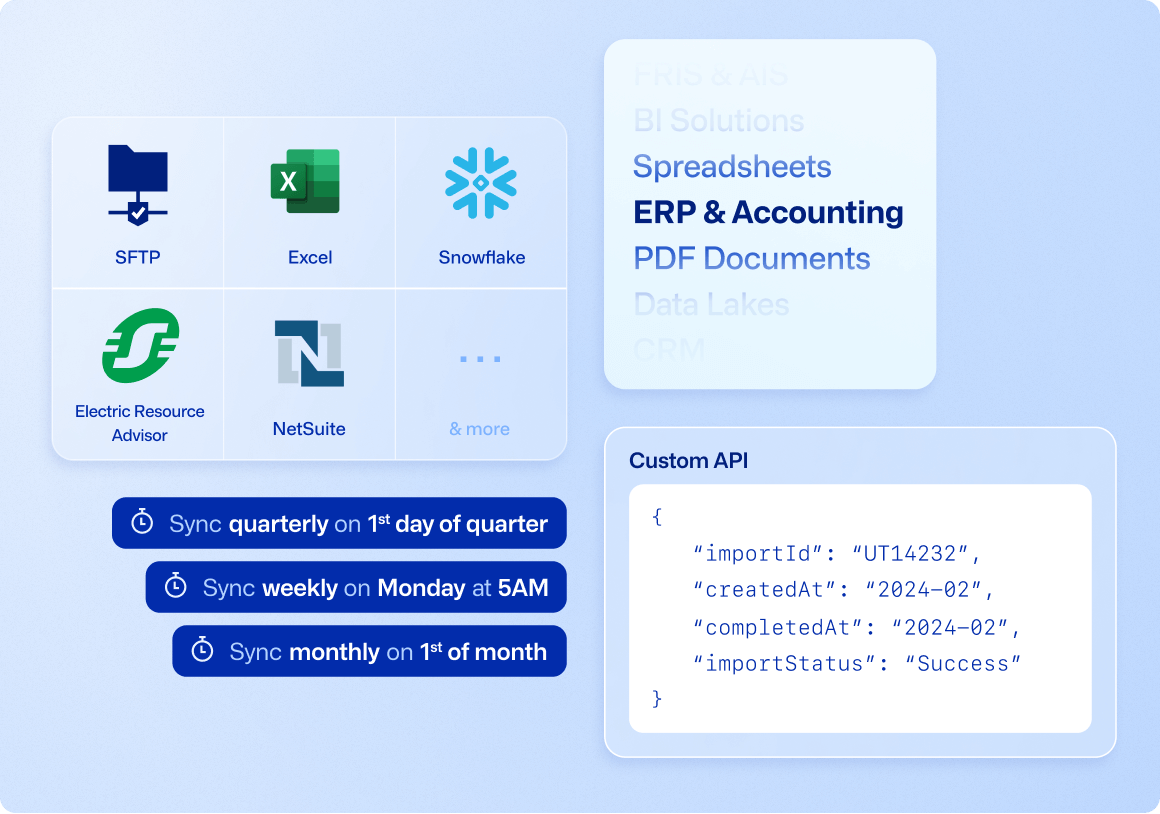
The most effective approach is finding systems that meet you where you are: offering out-of-the-box integrations where possible, but also supporting custom APIs for more complex needs, all while maintaining control through robust variance checking and approval workflows.
This strategic approach to automation can cut data processing time while actually improving data quality.
Close the gap between data and insight
Even with automated data flows, some organisations still wait weeks (or longer) for emissions calculations. And if you’re relying on consultants, months isn’t unusual.
It’s not for lack of tech, it’s because footprinting at enterprise scale is complex. You’re dealing with different data types, inconsistent formats, incomplete inputs, and custom methodologies.
So real-time footprinting requires more than fast ingestion. It needs:
- A strong underlying data model
- Validation and approval at the input stage
- A powerful engine to match source data to the right emission factors
- Transparent processing, no black box
The goal isn’t to automate everything blindly. It’s to generate accurate, timely footprints that actually help you decide what to do next.
And the faster you can see results, the faster you can adapt, whether that’s course-correcting a programme, justifying investment, or showing real progress to leadership.

It’s about momentum
The more friction there is in your environmental data pipeline, the slower everything else becomes. Delayed insights lead to delayed action. And delays are expensive: in time, in credibility, in missed opportunities.
But when ingestion is effortless, automation is focused, and footprinting is fast, the entire system starts to move with you, not against you.
That’s what creates momentum. And that’s what gets you from measurement to meaningful decarbonisation - faster.
When enterprises invest billions to improve the flow, quality and accessibility of their financial operational data, they expect the same standards from their sustainability systems. The organisations that recognise this shift early will find themselves better positioned to make decisions that actually drive decarbonization, rather than just measure it.
