
As of March 2026, Minimum.com has been acquired by Novisto - cemeting Novisto’s position as the most comprehensive, "all-in-one" sustainability platform, designed to serve as the single source of truth for global enterprises navigating an increasingly complex regulatory landscape.

Inventory Management Plans: the unsung hero of decarbonisation
There’s a reason so many carbon reduction efforts stall before they’ve even really begun: the data isn’t in place to make informed decisions.
The truth is, if you can’t see what’s going on, you can’t change it. And if your carbon inventory is buried in a static PDF or scattered across spreadsheets, you’re starting from behind. This is where the inventory management plan comes in - and no, we’re not talking about a consultant-delivered appendix to a footprint report. We’re talking about something much more dynamic. Something foundational.
Why you need more than a PDF
Plenty of companies have what they think is an inventory plan. But in reality, it’s often a document created after a footprint is calculated - useful for auditors, maybe, or onboarding someone new, but not much else.
The problem is decarbonisation isn’t a backwards-looking exercise. It’s an operational challenge that demands real-time visibility and a structured, adaptable data layer.
A proper inventory management plan is the tool that makes that possible.
What a good inventory plan actually looks like
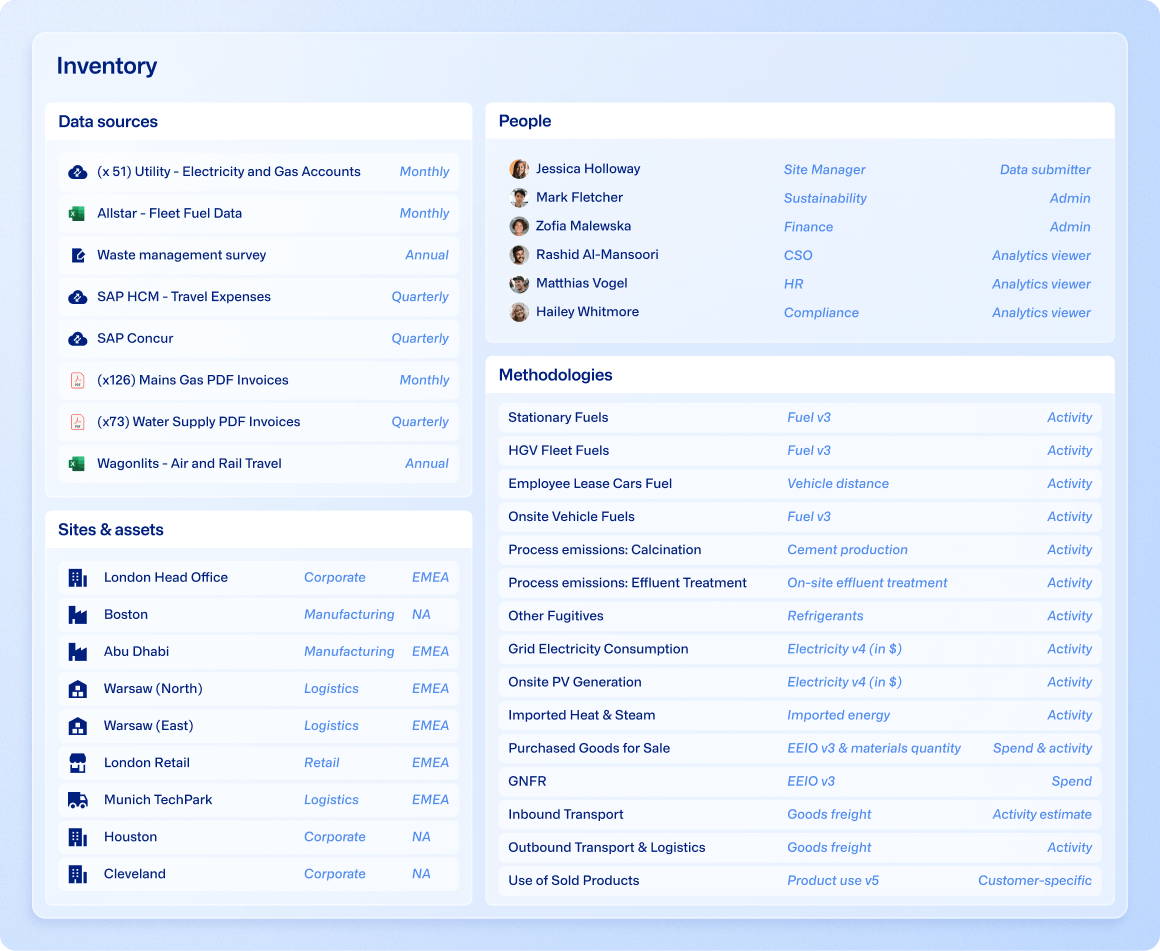
A real inventory management plan isn’t just a snapshot. It’s a living map of how your organisation collects, stores, and interacts with environmental data across the business.
It captures:
- Every site, asset, and facility
- Data collection frequencies and sources
- Methodologies, assumptions, and estimates
- Responsible users and audit trails
- Current-state data and future collection plans
In other words, it connects the dots between business activities and environmental impact - across carbon, water, energy, waste - and it evolves alongside your organisation.
This is only realistically achievable through software. The volume, complexity, and changeability of the data involved make Excel and PDFs insufficient. You need something that reflects the real world, not a static version of it.
How it makes actual decarbonisation possible
Once your inventory is mapped, everything gets easier.
You can see where data is missing or poor quality. You can figure out where to focus efforts to automate more of the collection process. You can standardise methodologies, reduce duplication, and spot where high-impact interventions might be hiding.
You move from “collecting for compliance” to collecting to drive action. And that shift can save hundreds of hours, freeing your team up to focus on what makes a measurable difference.
Without a proper inventory plan, you're effectively flying blind. With one, you get a strategic view of your entire emissions landscape, and a foundation for measurable progress.
The right foundations now save pain later
Getting this right upfront is the difference between a decarbonisation programme that feels like a grind and one that runs with momentum.
At Minimum, this is why we built Carbon Atlas™, to make it possible to model your organisation in all its complexity, and to keep that model up to date as your business evolves.
Because ultimately, your ability to reduce emissions depends on your ability to understand them. And that starts with an inventory management plan that’s built for action.
Curious what a live, evolving carbon inventory could look like in your organisation?
Get in touch with our team - we’d be happy to show you.
This is foundational. Because without it, you’re flying blind.
